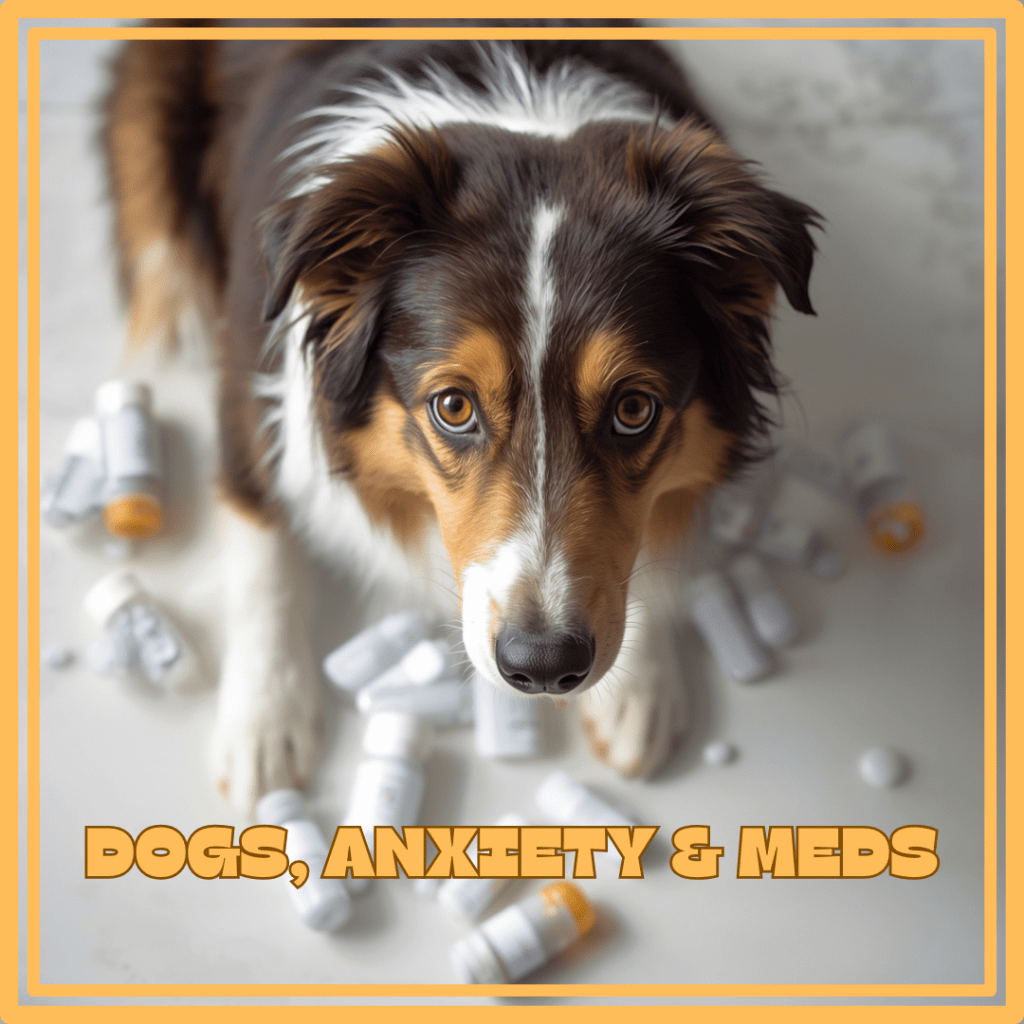
For years Cookie spent more time feeling the slow, dull effects of medication than the joy of play. We started with trazodone for short emergencies. It was supposed to calm her. Instead, it made her nauseous and constantly sleepy. Fluoxetine came next and upset her stomach badly; paroxetine was easier on her, but still didn’t fix everything. The medications gave us breathing room. While they were helping, I did the hard work. This included months of structured training, steady routines, and games that made Cookie think, choose, and solve problems. The drugs were scaffolding; the lessons were what endured.
In recent months, when it felt right, I began to taper her medications. I did not do it blind. I watched and logged. I spoke to our veterinarian and to our trainer along the way. I understood the risks: many of these drugs work quickly or broadly enough to change a dog’s outward arousal without fixing the neural circuits beneath. And when a steady pharmacologic effect is removed the brain often overshoots in its attempt to rebalance. Researchers call that discontinuation syndrome, a temporary hyperreactivity, sleep‑trouble, or gastrointestinal distress that can look dangerously like relapse.
If you imagine a nervous system as a sea level set by tides of neurotransmitters, the drugs raise that level; the brain builds levees and adjusts pumping stations to accommodate the new normal. When the external tide drops, the pumps don’t stop immediately. For some dogs, the result is weeks of stormy seas: startle responses, avoidance, worse sleep, and behaviors that make owners panic and call for the pill back. That biological truth is why the common advice is not to stop cold but to taper slowly, to let the brain find its rhythm again without being shoved. It is also why medication without behavioral work feels like buying a fire extinguisher and then letting the house burn around it.

And yet Cookie’s story did not follow the worst of those scripts. As I reduced her dose in small, deliberate steps, she brightened rather than frayed. She grew more energetic and more playful. Her prey drive, the thing that had always made me nervous because other people mistake it for trouble, returned as a tool. She throws herself at the flirt pole, grips the herding ball and watches the world at the edge of the park with renewed curiosity. Instead of seeing a dog slide back into old anxieties, I watched a dog remember how to be engaged. For me, that mattered more than anyone’s idea of “calm.”
Why did Cookie emerge better rather than worse? I think the answer is not mystical but cumulative. The medicines never stood alone: they were paired with months of behavioral training that taught her how to face stressors and succeed at small, repeated tasks. We tapered slowly, giving her neurochemistry time rather than yanking at it. We monitored her physical health closely; early in her drug history, gastrointestinal reactions had forced us to change course, and we have been careful ever since. Finally, we used enrichment that matters i.e., consistent exercise, play that channels instinct, predictable daily patterns. Those are the things that release the same growth and learning chemicals the drugs were intended to modulate.

That does not mean discontinuation syndrome is a myth or that every taper will be smooth. For some animals, even gradual reductions produce turbulence, and for younger animals or those with certain histories the outcomes can be different. The humane choice is to assume the brain will need time and support, to keep the channels of communication open with veterinarians, and to be ready to pause a taper if a dog’s health or safety is at stake.
For me, the point of medication was never to mute Cookie’s selfhood. It was to quiet the current long enough that she — and we — could learn better ways to cope. When that learning takes, when play and attention return, when prey drive becomes a lever rather than a liability, then the pill has done its job and the rest belongs to training, routine, and daily care. Watching Cookie run again, mouth open and eyes bright, I am reminded that resilience is not conferred by a bottle but grown in the daily, ordinary work of being a dog and being a person responsible for one.

If you’re thinking of starting or stopping these medications for your own animal, remember two things: expect the brain to be a little messy when it re‑levels, and build the scaffolding around the dog before you change the chemistry.
Cookie’s return to herself is not a universal promise, but it is a believable result when medicine, patience, and training are allowed to do what each does best.
Some scientific studies and explanatory videos by Dr. Melanie Uhde that framed much of my thinking are available here:
- Behavioral rehabilitation of extremely fearful dogs in Applied Animal Behaviour Science.
- Real-world data on behavioral practices for dogs in primary care veterinary hospitals in the United States (2010–2020) in Journal of the American Veterinary Medical Association
- THIS is your Dog’s BRAIN on Anxiety Drugs by Dr. Melanie Uhde
- What REALLY Happens When You Quit Your Dog’s Anxiety Meds by Dr. Melanie Uhde
- For more information on canine health and welfare by Dr. Uhde see https://www.caninedecoded.com/freebies
✨ I and my husband have used antidepressants for many years and continue to do so; they have been incredibly helpful and life‑changing for us. I am not suggesting that antidepressants are bad or that medication has no place for dogs, far from it. My point is that these medicines are powerful tools that deserve respect and thoughtful use, paired with training and careful monitoring so a dog can regain capacity, not just quiet ✨
With love Cookie and Seda🍄🟫
 Bytesize Cookie